What Dispersant to Use for Graphite Slurry? A Stable Dispersion Approach
Conclusion in one sentence: The key to stable dispersion of graphite slurry lies in a three-step coordination of “wetting – dispersing – suspending”: use anchoring polymeric dispersants to break agglomerates and suspension stabilizers to prevent sedimentation and re-agglomeration; Toynol® DS series (polymeric dispersants) + AN series (suspension stabilizers) are a viable combination, but because graphite and carbon black have different surface properties, formal product selection must be validated with a dose-response study using the actual formulation.
1. Why is Graphite Slurry Difficult to Disperse?
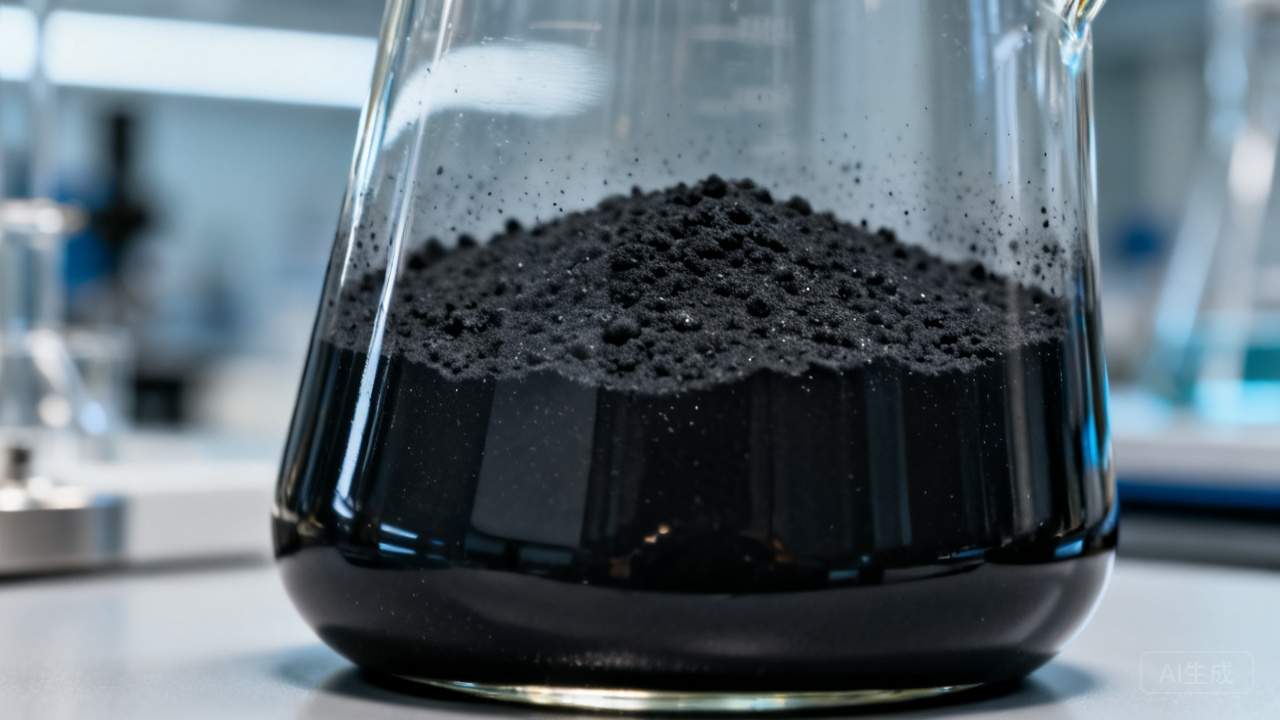
Graphite slurries are commonly found in conductive pastes, lithium battery anode slurries, conductive inks, etc. The dispersion difficulties are similar to carbon black but not identical:
- Plate-like structure prone to stacking: Flake graphite and spherical graphite have lamellar/granular structures; lamellae easily stack face-to-face, and once agglomerated they are hard to redisperse;
- Hydrophobic surface: Graphite has few polar functional groups on its surface, leading to poor wettability in waterborne systems, with particles floating on the surface or aggregating;
- Density and particle size differences: Graphite density (~2.2 g/cm³) differs significantly from the dispersion medium; after standing, settling and separation occur, resulting in poor storage stability;
- Conductive network trade-off: Conductive pastes require graphite particles to contact each other to form conductive pathways, but also need sufficient dispersion during the paste-making stage — over-dispersion destroys conductivity, while under-dispersion fails to meet fineness requirements, requiring a balance.
Core mechanism: Dispersants break agglomerates through “anchoring adsorption + steric hindrance/electrostatic repulsion”; suspension stabilizers “hold” the dispersed particles in place via thickening and gel network formation, preventing sedimentation and re-agglomeration. Using both together solves the two problems of “cannot be broken apart” and “settles too fast.”
2. Graphite Slurry Dispersion Product Selection Approach
First, lock the dispersant direction based on “graphite type + system polarity,” then add a suspension stabilizer to address storage stability, and finally conduct a dose-response study using the “fineness – viscosity – sedimentation” three-indicator approach to determine the product grade and dosage.
3. Toynol® Solution: Dispersant + Suspension Stabilizer Combination
Toynol® has published application solutions for conductive carbon dispersion (see “Conductive Carbon Black Dispersion” case on the official website); graphite slurries can be referenced by analogy:
3.1 Dispersant: DS Series (Polymeric Dispersants)
- Function: Anchoring adsorption on the graphite surface, providing steric hindrance to break agglomerates, and controlling slurry fineness and viscosity;
- Application: Waterborne graphite/carbon material slurry systems;
- Typical dosage: Perform dose-response studies starting from the recommended initial dosage in the TDS (generally 0.5%–2% based on active dispersant weight relative to powder); finalize by lab testing.
3.2 Suspension Stabilizer: AN Series
- Function: Forms a weak gel network in the system to support graphite particles, delay sedimentation and separation, and improve storage stability;
- Application: Graphite slurries with high solids content or prone to sedimentation;
- Note: Suspension stabilizers affect slurry viscosity and rheology; the dosage must be balanced with the dispersant to avoid excessive viscosity that hinders application/coating.
3.3 Wetting Aid
- Waterborne systems can be supplemented with Toynol® acetylenic diol wetting agents (e.g., FS series) to improve wetting and spreading on the graphite surface, accelerating the dispersion process;
- Wetting agents do not act as dispersants and cannot replace them.
Important note: Graphite and carbon black have different surface functional groups and structure levels. The carbon black case on the official website cannot be directly applied to graphite systems. Before formal product selection, perform lab testing with the customer’s actual formulation (resin/binder/solids content/process) or contact the Hi-Perferal technical team for sample evaluation.
4. Application Considerations and Common Pitfalls
- Wet first, then disperse: Recommended addition order: dissolve wetting agent/dispersant in water first → add graphite in portions → high-shear dispersion. Avoid adding dry powder all at once to prevent large agglomerates.
- Shear intensity and time: Insufficient shear fails to break agglomerates; excessive shear may damage the graphite lamellar structure (affecting conductivity and electrochemical performance). Find the optimal window.
- Anti-sedimentation is critical: Graphite is dense; relying solely on dispersant is insufficient for long-term anti-sedimentation. Ensure addition of a suspension stabilizer or suitable rheology modifier.
- Conductivity verification: After dispersion, measure the coating conductivity/electrode resistance to confirm the dispersion scheme has not destroyed the conductive network.
- Storage stability tracking: Observe sedimentation and viscosity drift after 7 and 30 days. Finalize the formulation only after stability is confirmed.
Frequently Asked Questions (FAQ)
Q1: What dispersant should be used for graphite slurry?
A: Prioritize anchoring polymeric dispersants (e.g., Toynol® DS series) combined with a suspension stabilizer (AN series) to prevent sedimentation. Specific product grade and dosage must be validated through a dose-response study with the actual formulation, referring to the TDS.
Q2: What is the difference between a dispersant and a suspension stabilizer?
A: The dispersant is responsible for “breaking apart” — dispersing agglomerates into fine particles; the suspension stabilizer is responsible for “holding” — preventing the dispersed particles from settling and re-agglomerating. They work together, not as substitutes.
Q3: What should be done if graphite slurry delaminates or settles after storage?
A: First, check whether dispersion is sufficient (whether fineness meets requirements); second, add suspension stabilizer to adjust rheology; third, re-homogenize. For a long-term solution, perform a 7-day/30-day storage stability test before finalizing the formulation.
Q4: Can Toynol®’s carbon black dispersion solution be directly used for graphite?
A: No, it cannot be directly applied. Graphite and carbon black have different surface properties. The conductive carbon black case on the official website can be used as an analogous reference, but formal use requires actual testing with the graphite formulation.
Q5: What happens if too much dispersant is added?
A: Excess dispersant may increase slurry viscosity, affect the conductive network, or waste cost. Perform a dose-response study starting from the TDS recommended dosage to find the balance point where “fineness is acceptable + viscosity is controllable + stability without sedimentation.”
Key Conclusions
- Graphite slurry dispersion is challenging due to lamellar stacking, surface hydrophobicity, and sedimentation; it requires a three-step combination of “wetting + dispersing + suspending.”
- Dispersants (DS series) break agglomerates; suspension stabilizers (AN series) prevent sedimentation; they should be used together.
- Selection approach: lock direction by graphite type and system polarity → determine product grade and dosage via dose-response study → validate with fineness/viscosity/sedimentation indicators.
- Carbon black solutions can be used as an analogous reference but cannot be directly copied; formal selection must be based on actual customer formulation testing and TDS.