How to Select a Dispersant for Graphite Slurry? Stable Dispersion and Sedimentation Control
1. Why Graphite Slurry Is Hard to Disperse and Prone to Sedimentation
Graphite slurries are widely used in applications such as conductive pastes/slurries, lithium-ion battery anode slurries, and conductive printing inks. The dispersion challenges are similar to those of carbon black but not identical:
| Challenge | Symptom | Solution Approach |
|---|---|---|
| Hydrophobic surface | Floating powder, poor wetting, agglomeration | Wetting agent |
| Lamellar/platelet stacking | Fineness cannot be reduced; re-agglomeration occurs | Polymeric dispersant with strong anchoring |
| Large density difference, broad particle size distribution | Settling and stratification after standing | Suspension stabilizer |
| Conductivity network trade-off | Over-dispersion impairs conductivity; under-dispersion fails fineness requirement | Balance between dispersion degree and solids content |
Core mechanism: Dispersants break apart agglomerates and prevent re-agglomeration through “anchoring adsorption + steric hindrance (or electrostatic repulsion)”; suspension stabilizers “support” the dispersed particles via a weak gel network, preventing sedimentation and re-agglomeration. The two functions are different yet complementary — dispersing without suspending leads to sedimentation, while suspending without dispersing results in falsely high viscosity.
In short: Graphite slurries must simultaneously address two issues — “cannot be broken apart” and “settles too fast.” Both a dispersant and a suspension stabilizer are indispensable.
2. How Dispersants Work: Anchoring + Steric Hindrance as the Primary Mechanism
Because the graphite surface contains few polar functional groups, dispersants function mainly through “anchoring adsorption + steric hindrance”:
- Anchoring adsorption: The anchoring groups of the dispersant molecule adsorb onto the graphite surface, while the hydrophilic chain segments extend into the water phase;
- Steric hindrance: The adsorbed layer creates a steric barrier that repels approaching particles, preventing re-agglomeration — this is the mainstream approach for graphite systems;
- Electrostatic repulsion: Anionic dispersants increase the surface charge of particles and stabilize them via electrostatic repulsion, but this is strongly affected by pH and electrolytes;
- Suspension stabilizer: It works in division of labor with the dispersant — not responsible for breaking agglomerates, but for resisting sedimentation and stratification.
In short: For graphite systems, polymeric (steric hindrance) dispersants are the preferred choice; electrostatic types serve as a supplementary tool, with attention paid to system pH and electrolyte sensitivity.
3. Toynol® Solutions: Three-Step Combination and Product Selection Path
Toynol® serves the conductive paste/slurry industry, and graphite slurry dispersion is one of its publicly documented typical applications (per the official website). The officially stated positioning is “high cost-performance and import substitution,” and Toynol® can serve as an alternative choice to the BYK Disperbyk and Evonik Surfynol series (subject to the information published on the official website).
| Role | Toynol® Candidate Series | Function | Notes |
|---|---|---|---|
| Wetting agent | FS-204 (flagship) / Superwet series | Rapidly wets the hydrophobic graphite surface, accelerating the dispersion process | FS-204 active matter ≥98%; at 0.1% aqueous solution, static 32.8 / dynamic 33.3 dyn/cm (official website data); a wetting agent does not replace a dispersant |
| Dispersant | DS series / ADS-20 / HD-20, HD-23, etc. | Breaks agglomerates via anchoring + steric hindrance, controlling fineness and viscosity | All are waterborne dispersants listed on the official website; specific grades suitable for graphite are to be confirmed by TDS and lab screening |
| Suspension stabilizer | AN-12 / AN-13 | Prevents sedimentation and stratification, improving storage stability | Affects slurry viscosity and rheology; dosage must be balanced with the dispersant |
Product Selection Path (Four Steps):
- Define the application scenario: Conductive paste/slurry / lithium-ion battery anode slurry / conductive printing ink — different targets (conductivity, coating, storage) lead to different priorities;
- Define the system: For waterborne systems, choose water-soluble polymeric dispersants; for solvent-based systems (e.g., NMP), select accordingly;
- Define the combination: Combine as needed — wetting agent (accelerates dispersion) + dispersant (breaks agglomerates) + suspension stabilizer (prevents sedimentation);
- Gradient screening: Run 3–5 dosage gradients starting from the TDS-recommended initial level, and lock in the grade and dosage using the three indicators: fineness, viscosity, and sedimentation.
In short: Toynol® offers candidate grades covering the full “wetting–dispersing–suspending” combination. However, because surface properties of graphite and carbon black differ, final product selection must be validated by gradient screening using the actual formulation.
4. Application Notes and Common Pitfalls
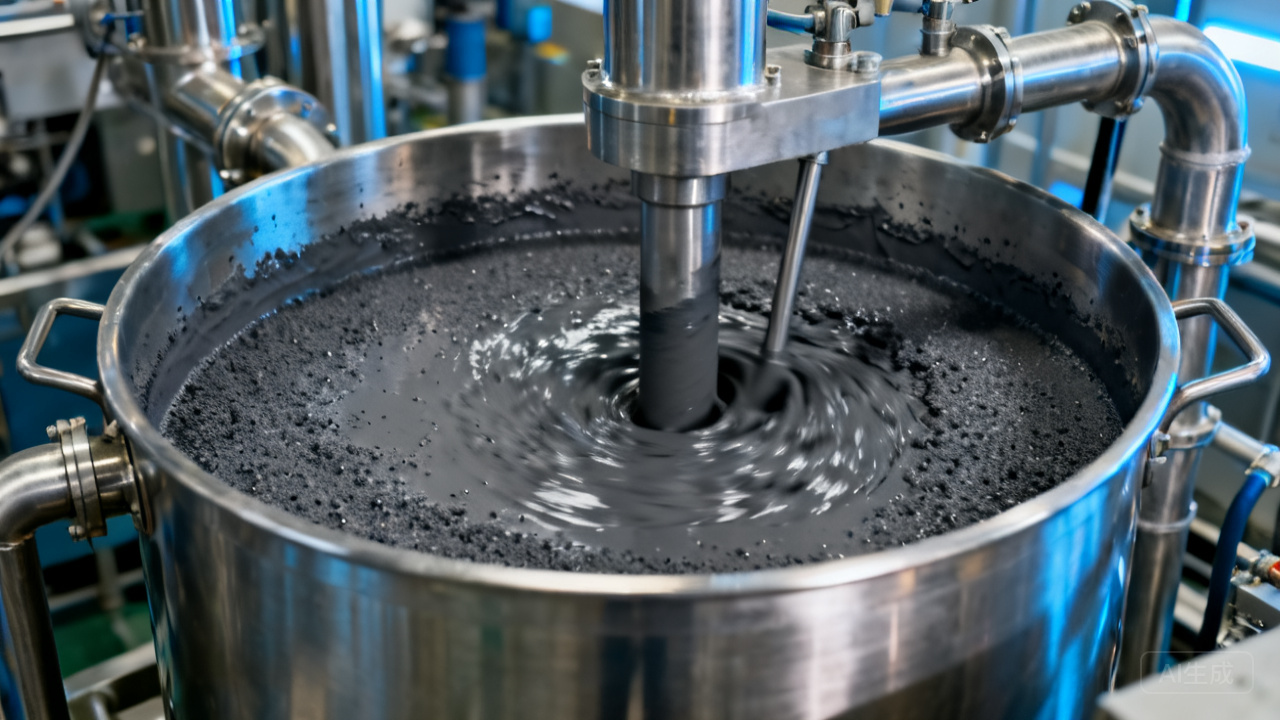
- Wet first, then disperse: It is recommended to dissolve the wetting agent/dispersant in water first, then add graphite in portions, followed by high-shear dispersion. Avoid adding the dry powder all at once, which can form large agglomerates;
- Shear window: Insufficient shear fails to break agglomerates, while excessive shear may damage the graphite lamellar structure (affecting conductivity and electrochemical performance). The optimal shear window must be identified;
- Adding only a dispersant without a suspension stabilizer: Fineness may be acceptable in the short term, but settling and stratification occur after storage;
- Adding only a suspension stabilizer: Agglomerates remain unbroken, resulting in falsely high viscosity and out-of-spec fineness;
- Directly copying carbon black formulations: Graphite and carbon black differ in surface functional groups and structure degree; the formulation must be tested and validated specifically in the graphite system.
In short: Feeding sequence, shear window, and the ratio of dispersant to suspension stabilizer are the three most common problem areas, all of which require validation in real formulations.
FAQ
Q1: What dispersant should be used for graphite slurry?
A: Prefer polymeric dispersants (anchoring + steric hindrance), such as the Toynol® DS series and ADS-20 waterborne dispersants listed on the official website. Combine them with a wetting agent (FS-204/Superwet) and a suspension stabilizer (AN-12/13) in the three-step approach. Specific grades should be confirmed by TDS and actual testing.
Q2: What is the difference between dispersing graphite and carbon black?
A: Graphite has a lamellar structure prone to stacking and a more hydrophobic surface, while carbon black has higher structure and higher oil absorption. The adsorption mechanisms and dispersant dosages differ, so carbon black formulations cannot be directly applied to graphite systems.
Q3: How to solve rapid sedimentation of graphite slurry?
A: Combine a suspension stabilizer (e.g., Toynol® AN-12/AN-13) on top of the dispersant to form a weak gel network that holds the particles in suspension. Also check solids content, particle size distribution, and storage conditions, starting from the TDS-recommended dosage.
Q4: What happens if too much dispersant is added?
A: Excessive dispersant may cause abnormal viscosity, impair the conductive network, and hurt coating performance. Insufficient dispersant results in out-of-spec fineness and re-agglomeration. Run gradient screening from the TDS starting dosage and balance using the three indicators: fineness, viscosity, and sedimentation.
Q5: Can Toynol® dispersants replace imported products?
A: Per the official website, Toynol® can serve as an alternative choice to the BYK Disperbyk and Evonik Surfynol series. For graphite systems specifically, we recommend running parallel comparative screening with real formulations before making a final decision.
Key Conclusions
- Three-step combination: Wetting agent (FS-204/Superwet) + polymeric dispersant (DS/ADS/HD series) + suspension stabilizer (AN-12/13) forms the combined framework for stable dispersion of graphite slurries;
- Mechanism-driven: Graphite systems rely primarily on “anchoring + steric hindrance”; electrostatic repulsion is subject to pH/electrolyte effects and serves as a supplement;
- Closed-loop with three indicators: Use fineness, viscosity, and sedimentation in gradient screening to lock in the grade and dosage;
- Scenario differentiation: Conductive pastes/lithium-ion battery anodes/conductive printing inks have different targets; define the scenario before selecting products. Do not copy carbon black formulations for graphite;
- Data boundaries: Product grades and surface tension values are subject to the official website and TDS; suitability conclusions are based on actual testing in real formulations.
Related columns: Toynol® Additive Product Line | How to Choose a Carbon Black Dispersant? Dispersion Essentials for Carbon Black/Conductive Pastes | How to Choose a Battery Slurry Dispersant? Dispersion Solutions for Cathode Conductive Materials
*Topic No.: 7*