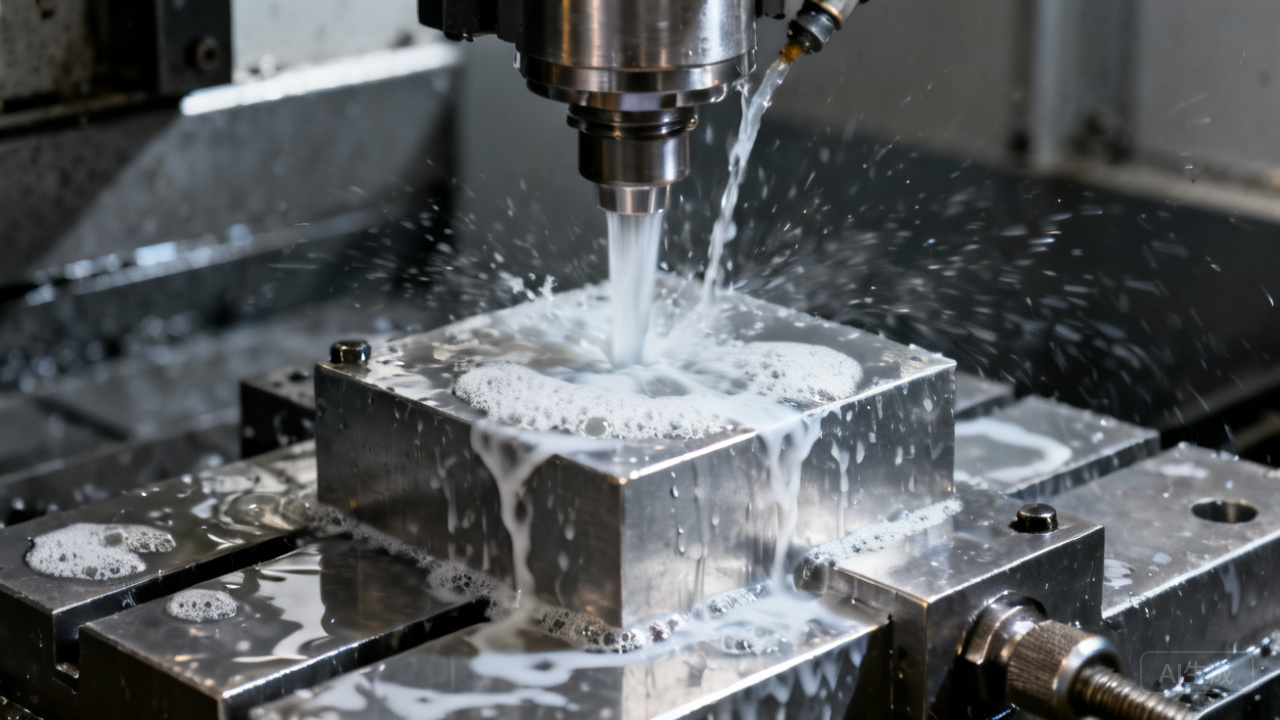
Total Solution for Foam Control and Wetting in Fully Synthetic Cutting Fluids
1. Technical Challenges Facing Fully Synthetic Cutting Fluids
Fully synthetic cutting fluids are the mainstream cooling media in metalworking. With excellent heat dissipation, cleaning capability, and environmental properties, they are widely used in precision machining operations such as turning, milling, grinding, and drilling. Compared with semi-synthetic fluids and emulsions, fully synthetic cutting fluids contain no mineral oil and are formulated entirely from water-soluble functional additives, offering long service life, good settling, and high clarity. However, the highly water-soluble nature of fully synthetic systems also brings two prominent challenges: difficult foam control and insufficient substrate wetting.
Foaming is particularly pronounced in fully synthetic cutting fluids. During use, the fluid passes through recirculating pumping, jetting, and filtration, and mechanical shear continuously entrains air, forming fine, dense foam. If foam is not eliminated promptly, it leads to lower fluid levels, reduced cooling performance, and impaired machining accuracy, and in severe cases can even cause pump cavitation. At the same time, excessive foam forms a bubble barrier layer on the workpiece surface, impairing the wetting and protection of the metal surface by the cutting fluid, which directly manifests as machining dimensional deviations and reduced surface finish.
The wetting problem is closely related to the penetration capability of the cutting fluid. In metalworking, especially high-precision grinding, the fluid must rapidly penetrate the minute gap between the grinding wheel and the workpiece to provide cooling and lubrication. Although conventional surfactants can lower static surface tension, under high-speed application conditions such as high-speed jetting and high-pressure cooling, the molecular migration rate cannot keep up with the rate of interface renewal, greatly diminishing the dynamic wetting effect.
According to industry survey data for metalworking fluids, among the technical pain points reported by formulators, foam control (about 38%) and dynamic wetting (about 29%) rank as the top two, making them the core development priorities for fully synthetic cutting fluid formulations.
2. Low-Foam and Foam-Suppression Mechanism of the Acetylenic Diol Gemini Structure
The core chemical backbone of acetylenic diol surfactants is 2,4,7,9-Tetramethyl-5-decyne-4,7-diol (CAS 126-86-3). Its molecular structure contains one carbon-carbon triple bond, with a diol group attached at each end, forming a distinctive “gemini-type” symmetric configuration. This structure gives acetylenic diol molecules unique technical advantages in metalworking fluid systems.
Defoaming mechanism at the molecular level. Acetylenic diol molecules are loosely arranged at the gas-liquid interface, and the foam films they form have low elasticity and rupture easily. Compared with conventional silicone defoamers, acetylenic diols leave no silicone residue on metal surfaces that could affect subsequent coating or heat-treatment processes; at the same time, their molecular structure contains no aromatic rings or alkylphenol groups and produces no APEO degradation products, complying with environmental regulations. Measured data show that acetylenic diol additives maintain stable defoaming efficiency over a wide temperature range (20-80 ℃), without the “temperature window” limitation common to silicone defoamers.
Low-foam characteristics with dynamic wetting. Acetylenic diols have a small molecular weight (about 210 g/mol) and a compact molecular structure, enabling them to migrate rapidly to freshly formed interfaces in short-duration processes such as high-speed jetting and impact. Research data show that the dynamic surface tension of a 0.1% aqueous solution at 25 ℃ (at 6 bubbles/s) is only 33.3 dyn/cm, very close to the static value of 32.8 dyn/cm, with a difference of less than 0.5 dyn/cm. This “dynamic-static balance” means that acetylenic diol additives maintain efficient wetting under dynamic conditions such as high-pressure cooling and spray cleaning, preventing dry spots or uneven wetting on the workpiece surface caused by local surface tension gradients.
Stability in hard water. Fully synthetic cutting fluids are typically prepared with tap water or industrial water of relatively high hardness, and calcium and magnesium ions significantly affect surfactant performance. As a nonionic surfactant, acetylenic diols are far less sensitive to hard water than anionic surfactants, maintaining stable foam control and wetting performance under high-hardness water conditions.
3. Toynol® Low-Foam Additive Product Line and Differentiated Positioning
Tianjin Hi-Perferal Advanced Materials Co., Ltd. has developed a complete Toynol® low-foam additive product line based on its acetylenic diol technology platform, offering differentiated solutions for fully synthetic cutting fluid formulations.
| Product Model | Chemical Type | Core Functional Positioning | Typical Viscosity Range | Suitable Applications |
| FS-204 | 2,4,7,9-Tetramethyl-5-decyne-4,7-diol | Dual wetting + foam control | Low to medium | General-purpose fully synthetic cutting fluids |
| FS-620E | Acetylenic diol polyether | Foam control first, with wetting | Medium to high | Heavy-duty cutting and grinding fluids |
| DF-80D | Acetylenic diol gemini-type nonionic structure | High-efficiency defoaming, rapid bubble breaking | Wide | Post-treatment defoaming of high-foam systems |
| Superwet-320 | Modified low-foam acetylenic diol | Low-foam wetting | Low to medium | Precision grinding, mirror finishing |
FS-204, as the base model of the Toynol® series, is the first choice for fully synthetic cutting fluid formulations thanks to its “one additive, dual effect” characteristics. It has an active matter content of ≥98% and appears as a white to light-yellow waxy solid. Adding 0.3%-0.8% (based on total formulation) to the cutting fluid system achieves simultaneous improvements in foam suppression and metal surface wetting. Because its molecular structure contains no ionic groups, it has good compatibility with the boron-based and phosphorus-based corrosion inhibitors and organic amine pH adjusters commonly used in cutting fluids.
FS-620E is positioned as a “foam-control-first” model, performing excellently in operations prone to heavy foaming such as heavy-duty cutting and deep-hole drilling. Its modified acetylenic diol polyether structure maintains low-foam characteristics while improving compatibility with high-viscosity systems, effectively avoiding floating oil on the fluid surface or workpiece contamination caused by additive separation.
DF-80D is a high-efficiency defoamer designed specifically for high-foam systems. Its gemini-type structure migrates rapidly to bubble surfaces and lowers the elastic modulus of the foam film to achieve rapid bubble breaking. At the same time, DF-80D offers long-lasting foam suppression that prevents foam rebound during recirculating use of the cutting fluid. It is recommended for high-finish grinding operations with strict appearance requirements.
Superwet-320 focuses on precision machining scenarios, and its low-foam wetting properties are especially suited to high-precision operations such as CNC grinding machines and mirror grinding. In grinding applications with ceramic CBN wheels or diamond wheels, Superwet-320 effectively reduces the contact angle between the grinding fluid and the wheel surface, improving coolant penetration efficiency in the grinding zone and reducing the risk of grinding burn.
4. Formulation Synergy Strategies and Practical Recommendations
In actual formulation development, Toynol® low-foam additives can be combined synergistically with other functional additives to build a complete fully synthetic cutting fluid system.
Basic formulation framework. A fully synthetic cutting fluid typically contains the following functional components: corrosion inhibitors (boron-based, phosphorus-based, organic amines), pH adjusters (organic amines, sodium hydroxide), lubricants (polyethers, fatty acid esters), extreme-pressure additives (sulfur-containing and phosphorus-containing compounds), preservatives, and additives. The acetylenic diol low-foam additive should be added in the middle-to-late stage, that is, after the other surfactants and functional additives have fully dissolved, to ensure uniform dispersion in the system.
Balancing foam control and wetting. For ordinary turning and milling, FS-204 (0.3%-0.5%) alone meets requirements; for grinding or high-pressure cooling systems, FS-620E (0.3%-0.6%) combined with DF-80D (0.1%-0.2%) is recommended — the former provides a persistent low-foam environment, while the latter offers rapid defoaming against sudden foaming.
Dosage adjustment under hard water conditions. In regions where water hardness exceeds 300 ppm, it is recommended to increase the acetylenic diol additive dosage by 20%-30% over the above levels to compensate for the competitive effect of hard water ions on the interfacial adsorption of surfactant molecules.
5. Development Trends and Conclusion
Acetylenic diol low-foam additives, with their unique gemini structure and low-foam foam-suppression properties, have established clear technical value in the metalworking fluid field. As precision machining develops toward higher speeds and higher pressures, the requirements for dynamic wetting performance of cutting fluids will continue to rise; at the same time, tightening environmental regulations will drive broader market acceptance of APEO-free, low-ecotoxicity acetylenic diol additives.
For metalworking fluid formulators, a deep understanding of the mechanism of acetylenic diol additives, together with proper product selection and dosage, is an effective path to solving the foam control and wetting challenges of fully synthetic cutting fluids and improving machining quality and production efficiency.
Tianjin Hi-Perferal Advanced Materials Co., Ltd. will continue to focus on the fine chemicals sector, centered on the Toynol® and Vanconol® brands, providing customers with high-quality corrosion inhibitors, coolant additives, and other high-performance chemicals, along with professional technical support and customized solution services.
We look forward to partnering with more metalworking system companies to jointly promote the healthy development of the heat-dissipation technology industry.
For technical documentation or customized formulations, please contact us.