Wetting Agent Selection for Waterborne Adhesives on Low-Surface-Energy Substrates: Addressing Cratering, Fisheyes, and Insufficient Tack
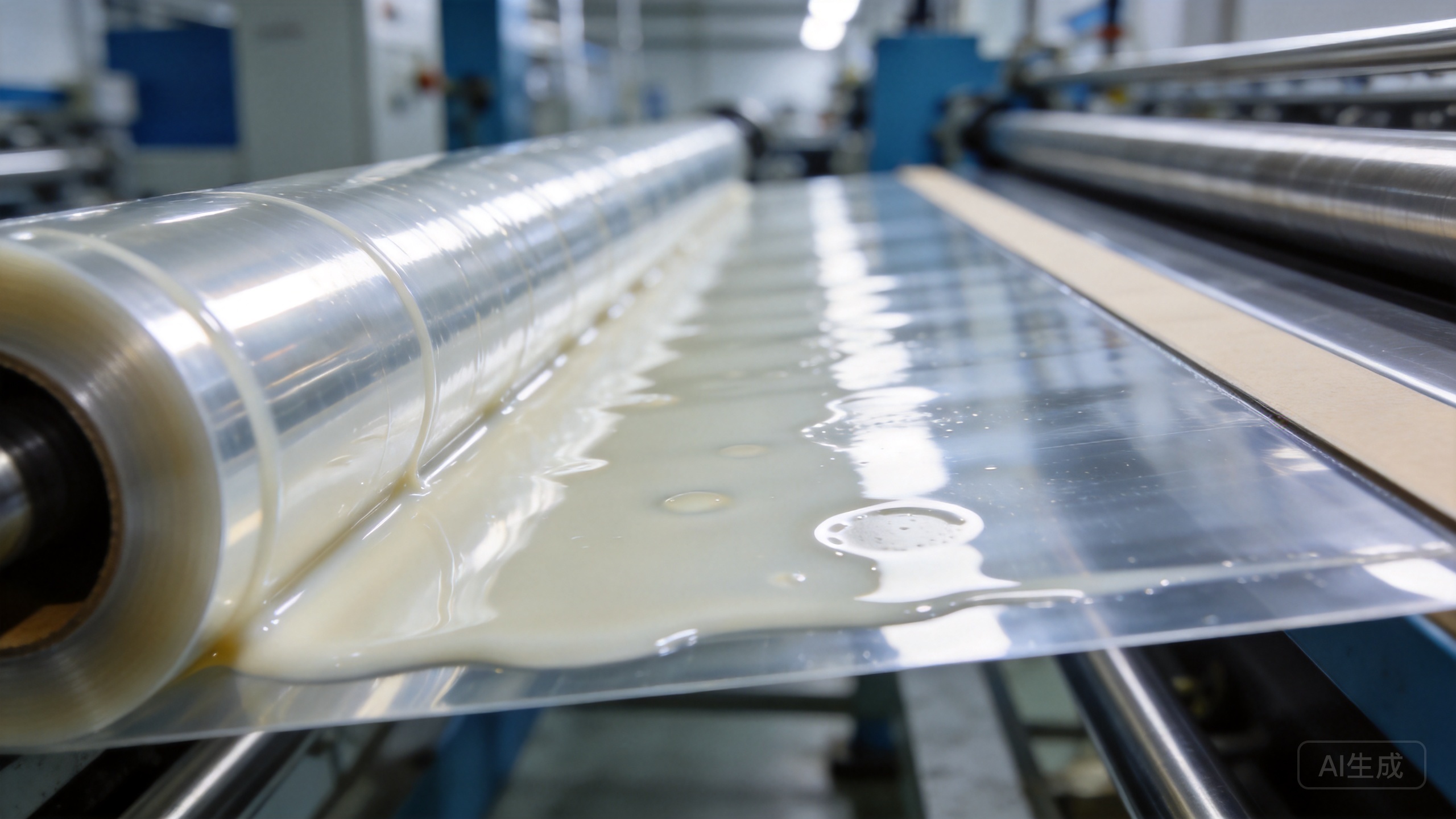
If you have ever applied waterborne adhesives onto films such as PET, BOPP, or PE, you have likely encountered this scenario: the adhesive film looks perfectly uniform as it exits the doctor blade, yet within seconds it contracts into circular patches on the film surface; or after drying, localized glossy areas appear as if nothing has bonded, and peel-off inspection reveals that those areas never actually wet the film surface. On purchase orders, such issues are often written up as “poor wetting,” but on the production floor, they are actually two different problems superimposed: one is cratering and fisheyes, and the other is insufficient tack. The former is a physical phenomenon at the moment of coating; the latter is the final outcome of bonding performance. Both point to the same starting point—whether the adhesive can spread quickly over the substrate surface.
This guide breaks down wetting problems on low-surface-energy substrates into four independently assessable steps: first, how cratering and fisheyes form; second, the causal relationship between tack and wetting; third, a technical-dimension-based selection comparison; and finally, selection routes for specific substrates and process scenarios. All content is based on published product parameters, and any formulation- or field-data-specific statements are clearly marked with their source and evidence level.
1. How Cratering and Fisheyes Form: The Adhesive “Cannot Stay Spread” on the Substrate
Whether coating succeeds comes down to a simple criterion: is the surface tension of the adhesive lower than the critical surface tension of the substrate? Non-polar substrates such as PE, PP, and BOPP have critical surface tensions of only about 30 mN/m; PET is somewhat higher, but all are far below the 72 mN/m of water and the initial surface tension of most waterborne adhesives. When the adhesive’s surface tension is higher than the substrate’s surface energy, the liquid does not spread at the moment of contact but instead retracts into droplets—appearing on the film as circular patches with well-defined edges. Before drying, such patches are called craters; where a very thin adhesive layer remains at the center and appears as a bright ring under strong light, these are fisheyes. After drying, the transition ring at the edge looks whitish—what is commonly called white spots.
The key distinction is this: cratering and fisheyes result from “liquid retraction”—the center typically has no through-hole, the adhesive layer simply did not spread. In contrast, the pinholes and white spots discussed in Part 1 are traces of bubble collapse or retention. The former is a wetting issue, the latter a defoaming issue; using the wrong additive will only make the problem worse. The identification method is provided in Table 1-1 of Part 1 of this series and will not be repeated here.
2. The Causal Relationship between Insufficient Tack and Wetting
Tack has an often underestimated prerequisite: it is the product of contact area and force per unit area. If the adhesive wets the substrate poorly and the contact area is small, the result is insufficient tack no matter how good the adhesive’s viscoelasticity. This logic is especially evident on low-surface-energy substrates—many formulation engineers attribute insufficient tack to tackifying resin or PSA formulation ratios, but the first thing to check should be whether the adhesive actually covers the substrate.
The second time scale relevant to this issue is “spreading speed.” On a high-speed coating line, the adhesive typically has only fractions of a second to a few seconds from the coating head to the oven. Within this window, it is the dynamic surface tension (not the static value measured at 25°C) that determines whether spreading is completed. The closer the dynamic surface tension is to the static value and the faster it decays, the more readily the adhesive spreads over the freshly created interface. This is also why the wetting agents chosen for low-speed roll coating and high-speed blade coating are often not the same product—low-speed applications look at static values, high-speed at dynamic values.
It should be noted that wetting agents solve the “does it spread” problem; they do not change the adhesive’s own viscoelasticity or polarity matching. Simply attributing insufficient tack to a missing wetting agent will also miss the mark—the correct sequence is to confirm spreading first, then discuss formulation ratios.
3. Five Technical Dimensions for Wetting Agent Selection
3.1 Static vs. Dynamic Surface Tension: First Identify Which Parameter You Need
Static surface tension determines whether the adhesive can spread (thermodynamic criterion); dynamic surface tension determines how quickly it spreads (kinetic criterion). For high-speed coating and high-speed printing, prioritize the dynamic value; for slow roll coating and manual application, focus on the static value. To judge whether a wetting agent is suitable, you should obtain both sets of data rather than only looking at the most impressive figure on the product page.
3.2 Cloud Point: The Hidden Boundary of Process Temperature
The cloud point of a non-ionic wetting agent defines the upper temperature limit at which it remains clear in water. Above the cloud point, the additive separates from the aqueous phase and wetting performance is lost; it may also cause cloudiness or flocculation in the adhesive. Data measured at room temperature in the workshop is not the same as adhesive sitting at 40°C or 55°C in a summer storage tank. The actual system temperature must be included as a constraint during selection.
3.3 Ionic Character and System Compatibility
Anionic emulsifier systems (most acrylate emulsions and VAE emulsions are anionically emulsified) are generally compatible with non-ionic wetting agents; cationic systems require separate evaluation. If the charge of the ionic groups conflicts with that of the emulsifier, the wetting agent may lose effectiveness at best, or the emulsion may break at worst. The specific mechanisms and boundaries are covered in Part 4 of this series.
3.4 APEO Content
If your adhesive is used in food-contact packaging, infant products, or applications with environmental certification requirements, APEO-containing wetting agents are ruled out immediately. Before selection, confirm that the product label explicitly states APEO-free.
3.5 Balancing Wetting and Foam Control
Some wetting agents have inherent foam-control functionality (acetylenic diol types), resolving cratering without introducing a new foam burden. Others lower surface tension effectively but stabilize foam. For systems where foaming and cratering coexist, start with foam-controlling wetting agents to reduce compatibility friction when combined with defoamers.
4. Toynol® Wetting Agent Selection Comparison
The following parameters are taken from Toynol® product documentation and published information on the official website (evidence level A/B). Static and dynamic surface tension values are measured in 0.1% aqueous solution at 25°C. Products with the same chemistry but different carriers or forms are grouped together for comparison, making it easier to choose based on system constraints (odor, solvent sensitivity, storage conditions).
4.1 FS-204 Series: The Baseline Products
Table 4-1 FS-204 series comparison (same chemical structure, CAS 126-86-3)
| Product | Form/Carrier | Static surface tension | Dynamic surface tension | Published characteristics |
|---|---|---|---|---|
| FS-204 (acetylenic diol gemini type) |
White to light-yellow waxy solid (can be pre-melted by heating before addition) |
32.8 dyn/cm | 33.3 dyn/cm | Storage 5–40°C; packaging 25/180 kg; shelf life 2 years |
| FS-204PG | Non-ionic/gemini, liquid formulation | 37.7 dyn/cm | 38.5 dyn/cm | Adhesive applications: ensures uniform coating, suppresses foam during processing; addition sequence: after other surfactants and polymers, before pigments and fillers; APEO-free; packaging 25/180/950 kg; shelf life 2 years |
| FS-204BC | Liquid formulation | 37.7 dyn/cm | 38.5 dyn/cm | Packaging 25/180 kg |
| FS-204DPM | Liquid formulation | 37.7 dyn/cm | 38.5 dyn/cm | DPM carrier; suitable for evaluation in odor-sensitive systems |
FS-204 is a waxy solid that must be pre-melted by heating before use at low temperatures; liquid grades can be added directly. Which grade to choose depends mainly on your system’s constraints on carrier and form, not on surface tension data—liquid formulations of the same chemistry show nearly identical surface tension values.
4.2 Superwet Series: Low Surface Tension for High-Speed Scenarios
Table 4-2 Superwet series comparison
| Product | Chemical type | Static surface tension | Dynamic surface tension | Cloud point | Published characteristics |
|---|---|---|---|---|---|
| Superwet-320 | Acetylenic diol polyether non-ionic/gemini |
26.2 dyn/cm | 28.2 dyn/cm (at 6 bubbles/s) |
— | Waterborne PSA, laminating adhesives: improves coating uniformity, prevents bubbles, suitable for high-speed coating; stable performance under hard-water conditions; packaging 25/200/1000 kg; shelf life 2 years |
| Superwet-360 | Gemini-type non-ionic | 25.2 dyn/cm | 26.4 dyn/cm | — | Adhesives: improves substrate wetting and reduces bubbles during coating; published recommendation: add and fully disperse the defoamer first, then add this agent; packaging 25/200/1000 kg |
| Superwet-607 | Acetylenic diol non-ionic | 30.5 dyn/cm | 32.4 dyn/cm | — | Adhesives: improves coating uniformity on polymer substrates, meets high-speed coating requirements; good compatibility, low foam-stabilization tendency |
| Superwet-604 | Acetylenic diol structure, non-ionic | 26.1 dyn/cm | 28.1 dyn/cm | 27–33°C | Stable below cloud point; high-temperature applications require verification testing; packaging 25/200/1000 kg |
Superwet-604 has a cloud point of only 27–33°C; special attention is required during summer application or when oven front-zone temperatures are high. Treat the cloud point as a hard constraint during selection. Superwet-320 is the published recommended grade for high-speed coating of PSA and laminating adhesives.
4.3 BWA Series and D-502A: Adhesive-Specific Options
Table 4-3 BWA / D-502A comparison
| Product | Chemical type | Static surface tension | Dynamic surface tension | Cloud point/Ether cloud point | Published characteristics and dosage |
|---|---|---|---|---|---|
| BWA-930 | Acetylenic diol derivative blend | 36.5 mN/m | 46.8 mN/m | Ether cloud point (5% butyl ether aqueous solution) 36.5°C | Specifically developed for waterborne adhesives/coatings/printing chemicals; improves wetting on plastics, metals and wood, enhancing tack and final bond strength; foam height in 1% aqueous solution: 3 mm, 0 mm after 300 s; APEO-free; dosage 0.1%–1.0% |
| BWA-925 | Acetylenic diol derivative blend | 37.1 mN/m | 43.8 mN/m | Ether cloud point 44.0±2°C | Slightly higher static tension but lower dynamic tension, making it better suited to high-speed dynamic coating processes; dosage 0.1%–1.0%; packaging 25/200/1000 kg; shelf life 24 months |
| D-502A | Acetylenic diol and isomeric alcohol polyether (non-ionic) | 34.1 mN/m | 39.0 mN/m (at 6 bubbles/s) |
Cloud point 41°C | Suitable for high-speed application; for waterborne adhesives: improves substrate spreadability, enhances tack and application efficiency; dosage 0.2%–2%; packaging 25/200 kg; shelf life 24 months |
BWA-925 and BWA-930 differ in their static/dynamic surface tension profiles: for dynamic processes (high-speed coating/printing), prioritize the grade with the lower dynamic value. D-502A has a cloud point of 41°C and is likewise subject to process temperature constraints.
4.4 SI-800 and Foam-Controlling Wetting Agents: Specialized Scenarios
Table 4-4 SI-800 and foam-controlling wetting agents
| Product | Type | Static surface tension | Dynamic surface tension | Cloud point | Published characteristics and dosage |
|---|---|---|---|---|---|
| SI-800 | Silicone-based surfactant | 26.4 mN/m | 31.5 mN/m | — | Superior substrate wetting + leveling; in plastic coatings and adhesives: improves tack and final bond strength; dosage 0.1%–0.5%; packaging 25 kg; shelf life 24 months |
| FS-640 | Acetylenic diol polyether, non-ionic | 33.7 dyn/cm | 35.1 dyn/cm | — | Foam-controlling wetting agent; broadly compatible, low-VOC liquid product; suitable for high-speed coating in adhesive systems; dosage: refer to product documentation |
| FS-620 | Acetylenic diol polyether gemini | 33.2 dyn/cm | 34.3 dyn/cm | Approx. 34.5°C | Foam-controlling wetting agent; can serve as a defoamer alternative; in adhesives: improves initial wetting while controlling bubbles; note the cloud point constraint |
| FS-6502 | Acetylenic diol structure, non-ionic | 33.1 dyn/cm | 35.5 dyn/cm | — | Waterborne PSA, laminating adhesives: promotes uniform coating, suppresses foaming in high-speed coating; hard-water tolerance 500 ppm; dosage: refer to product documentation |
SI-800 is a silicone-based product with strong surface tension reduction and inherent leveling; however, the compatibility and recoatability of silicone-based surfactants in certain systems require separate evaluation. The foam-control approach of the FS-series foam-controlling wetting agents was introduced in Part 1, Section T-87 / D-502; the parameter tables are not repeated here.
5. Scenario-Based Selection Routes
Scenario A: Cratering/fisheyes in high-speed coating on PET film
Start with dynamic surface tension. PET is a medium-to-low surface energy substrate with a short high-speed coating window. It is recommended to run a dosage screening comparison starting with Superwet-320 (dynamic 28.2 dyn/cm) or BWA-925 (the lower-dynamic option at 43.8 mN/m). If foaming is also present, switch to a foam-controlling wetting agent such as FS-6502. See Section 7 for verification methods.
Scenario B: Insufficient tack on low-energy PE/PP substrates
First confirm whether spreading is complete, then address viscoelasticity. PE/PP have low critical surface tension, so static surface tension data is more critical. Superwet-320 (static 26.2 dyn/cm) or SI-800 (static 26.4 mN/m) can bring the adhesive’s surface tension below the substrate’s critical value. BWA-930 is explicitly described in published information as “enhancing tack and final bond strength,” making it a suitable candidate specifically for adhesives.
Scenario C: High-temperature season / elevated storage tank temperature (cloud point constraint)
First measure the actual system temperature, then screen products accordingly. Superwet-604 (cloud point 27–33°C), D-502A (41°C), and FS-620 (approx. 34.5°C) must all be re-checked under this constraint. If the cloud point is insufficient, turn to BWA-925 (ether cloud point 44.0±2°C) or T-87/D-502 (43–48°C; see Part 1 for parameters).
Scenario D: Foaming and cratering coexisting
This is the scenario that most requires “one product doing two jobs.” Acetylenic diol foam-controlling wetting agents (FS-640, FS-620, FS-6502, and T-87/D-502 from Part 1) lower surface tension while suppressing foaming tendency. If foam persists, add a bubble-breaking defoamer per Part 1, Section 2.1, noting the addition sequence.
6. Addition Timing and Dosage: General Guidelines
- Addition sequence: Published information generally recommends adding the wetting agent “after other surfactants and polymers, and before pigments and fillers.” At this point, the additive can distribute uniformly in the liquid phase for good spreading without interfering with the dispersion stage.
- Mixing: Stir thoroughly for 15–30 minutes after addition until uniform. If viscosity rises with certain products, moderate heating may be applied (FS-204 waxy solid must be pre-melted before addition).
- Dosage: Always begin a dosage screening from the lower end of the published range (e.g., BWA series 0.1%–1.0%; Superwet series per product documentation). On-site acceptance is based on “cratering eliminated with no new defects,” rather than simply applying the upper limit.
- Combination note: When used with a defoamer, Superwet-360’s published information recommends adding the defoamer first with thorough dispersion, then adding the wetting agent. This sequence prevents the wetting agent from “locking” foam into the system first.
7. Three-Step Field Verification Method
- Use the actual substrate (not a glass panel). Prepare small samples at the lower and middle dosages of the target range, and apply with the same doctor blade/rod used on-site. Observe whether the wet film still shows cratering or retraction.
- Measure the actual bonding performance after spreading (tack, peel strength) to confirm that “spreading well” truly translates into “bonding well,” rather than merely eliminating visual defects.
- Conduct thermal storage observation at 50°C or the actual storage temperature to re-check the risk of additive separation near the cloud point, and re-test adhesive viscosity stability.
8. Notes for Formulation Engineers
- When requesting quotations, ask for both static and dynamic surface tension data, and specify the test concentration and temperature. A data sheet reporting only a single value is insufficient to support high-speed coating selection.
- Include cloud point as a prerequisite in summer selection; do not wait until high-temperature problems appear to revise the formulation.
- Confirm whether the product is labeled APEO-free. For regulatory-sensitive systems, this should be the first item on your inquiry.
- SI-800 is silicone-based. For applications with high recoatability or re-bonding requirements, it requires separate evaluation and should not be the default first choice.
9. Inquiries and Samples
If you need a wetting agent dosage screening program for your specific substrate and coating process, or would like to request samples and TDS for the grades listed above, please contact us through the following channels. Our technical service team typically runs a round of bench-scale testing based on your substrate and process, then provides a field verification protocol.
- Company: Tianjin Hi-Perferal Advanced Materials Co., Ltd. (Hi-Perferal)
- Address: No. 2-1 Zhenghua Road, Caozili, Wuqing District, Tianjin, China
- Technical Service Hotline: 022-82910362
- Website: www.surfychem.com
Services: free samples, bench-scale formulation design, laboratory coating tests, and on-site process guidance.